
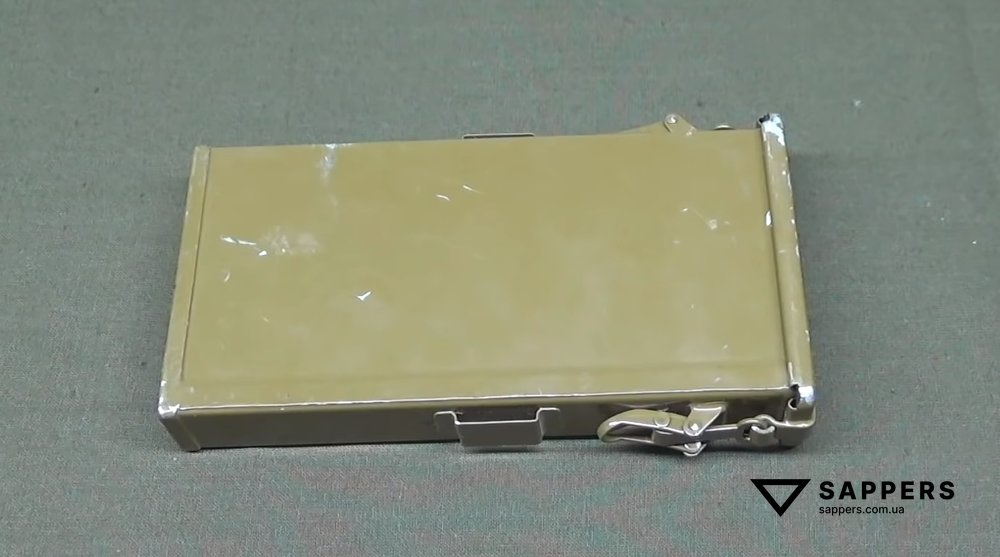
Technical and Tactical Characteristics of the MS-4 Mine
- Type of mine
- blast surprise mine, anti-transport, object mine, anti-lift device
- Body
- metal
- Weight
- 0.41 kg
- Weight of TNT explosive charge
- 0.12 kg
- Length
- 155 mm
- Width
- 92 mm
- Height
- 31 mm
- Type of target sensor
- vibration and tilt
- Tilt sensor sensitivity
- 20°
- Detonator
- built-in
- Fuze
- MD-9
- Time to combat-ready state
- from 15 minutes to 360 hours
- Operating temperature range
- -20 to +40 °C

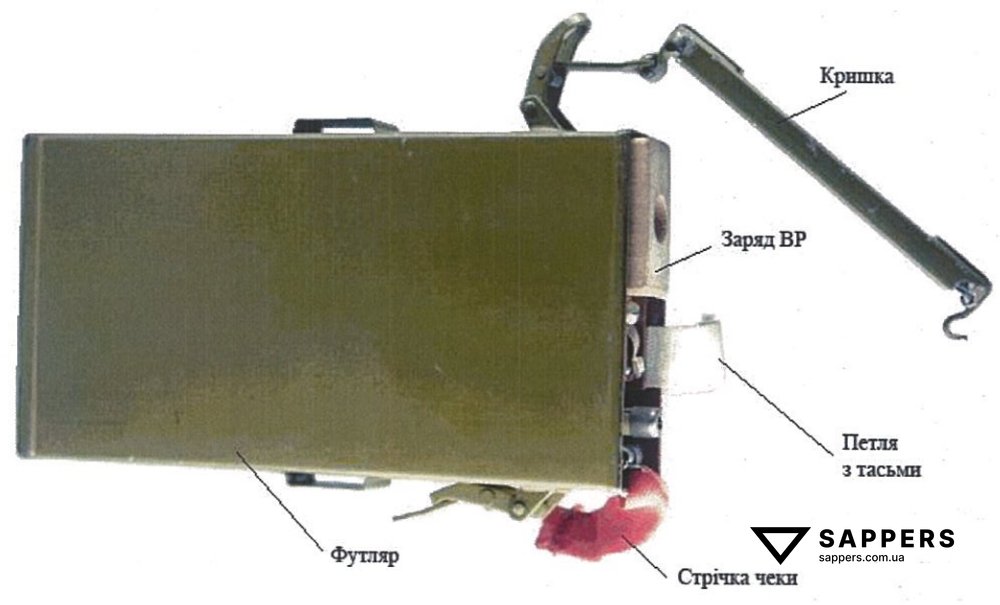
Due to its very small dimensions and very small explosive charge, the MS-4 mine can be used as a booby trap and as an anti-lift device for anti-personnel and anti-tank mines. When using the MS-4 as an object mine or anti-transport mine, it must be reinforced with a more or less substantial explosive charge and, in such cases, it may more accurately be referred to as a detonator or explosive device, since the detonation of the MS-4’s own charge serves as the detonator for the main explosive charge.
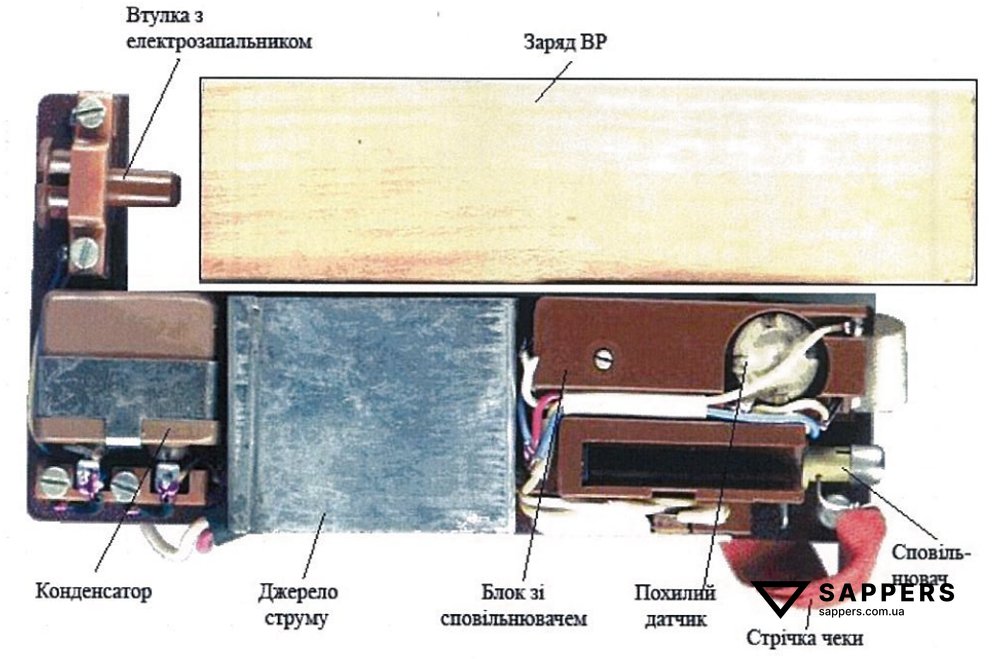
To perform the tasks assigned to the mine, it is equipped with the following target sensors:
1. Tilt sensor — actuates when the mine is tilted by more than 20° in any direction or when the mine is abruptly moved in any direction;
2. Vibration sensor — actuates from vibration caused by vehicle movement, oscillations of the mine caused by an attempt to move it from its position, pick it up, or attach something to it.
3. Timer — actuates after a preset time interval ranging from 15 minutes to 360 hours. Time measurement is discrete and is determined by the type of installed electrochemical cell. Accuracy is low, as it depends significantly on ambient temperature.
The nature of mine employment is selected by setting the rotary three-position switch-contactor, located under the mine cover, to a specific position and by setting the timer position:
1. Object-mine mode. Mode timer (switch position on the middle contact).
2. Booby-trap mode. Mode timer in delayed arming mechanism mode and tilt sensor (switch position: red ring), or the vibration sensor enabled (switch position: green wavy line).
3. Anti-transport mine mode. Timer enabled in delayed arming mechanism mode and vibration sensor enabled (switch position: green wavy line).
Access to the mine’s devices, power source, detonator, and charge is obtained by opening the mine cover, which is located on the end face of the mine and is secured by two box-type locks. After the mode is selected and the mine is switched on (delayed arming time: 10–20 minutes) and the cover is closed, the mine becomes non-render-safe and explodes upon an attempt to open the cover. Rendering safe the MS-4 mine is prohibited.

The mine has no time self-destruction devices, except in object-mine mode.
When used as an anti-lift device, the MS-4 mine is attached (glued or tied) to an anti-tank or anti-personnel mine in such a way that any attempt to remove the mine from its emplacement inevitably causes it to tilt or move with some acceleration. As a result, the MS-4 mine detonates, which in turn causes detonation of the main mine. The same mode is used when the MS-4 is employed as a booby trap. In this case, it is attached to an item that an enemy soldier may attempt to use (a weapon, household items, entrance doors and hatches, a desk drawer, etc.).
When used as an anti-transport mine, the MS-4 is placed inside or on the surface of a sufficiently powerful explosive charge, which in turn is placed under a road or railway bed, or a runway. The shock of dense soil caused by the movement of a passenger car is sufficient to actuate the vibration sensor. However, the reliability of the MS-4 in this capacity is not high, because it has no devices that allow the actuation moment to be adjusted, and it may detonate prematurely, for example, in front of a heavy truck or armored personnel carrier, or as a result of other munitions detonating on the ground. Detonation in front of a train occurs when it approaches to within 30–40 meters, which nevertheless does not prevent the train from crashing due to destruction of the railway track.
The mine’s service life in combat is limited by the operability of the power source, but is not less than 1 month. Under normal environmental conditions and with a fresh power source, the service life in combat is 3–4 months. This is the guaranteed period. In practice, such mines operate for a year or more.
Coloring
The mine body is painted matte olive green.
Marking
No markings are applied to the body. Small black ink triangular stamps with the letters OTK and process markings may be present. Some batches of mines may have metal loops on the side walls for securing the mine to an object or explosive charge.