Tactical and technical characteristics of the NVU-P firing device
- Type
- seismic, command-controlled, controlling 5 mines
- Body
- steel
- Weight
- 4.2 kg
- Diameter
- 155 mm
- Height
- 362 mm
- Mines used (standard)
- MON-100, MON-200, POM3-2, POMZ-M, OZM-3, OZM-4, OZM-160, OZM with UVK, POB (OZM-72, MON-50)
- Target sensor type
- seismic
- Target detection range
- 120-150 m
- Target recognition range
- 90 m
- Range for issuing the mine detonation command
- 5-20 m
- Time to transition to armed position:
MUV-4
MUV-2, MUV-2
6 - 36 min
13 min - 59 h- Self-destruction
- upon detonation of the last mine or by power source
- Combat operating time
- 4 - 9 months
- Operating temperature range
- -40 to +50 °C

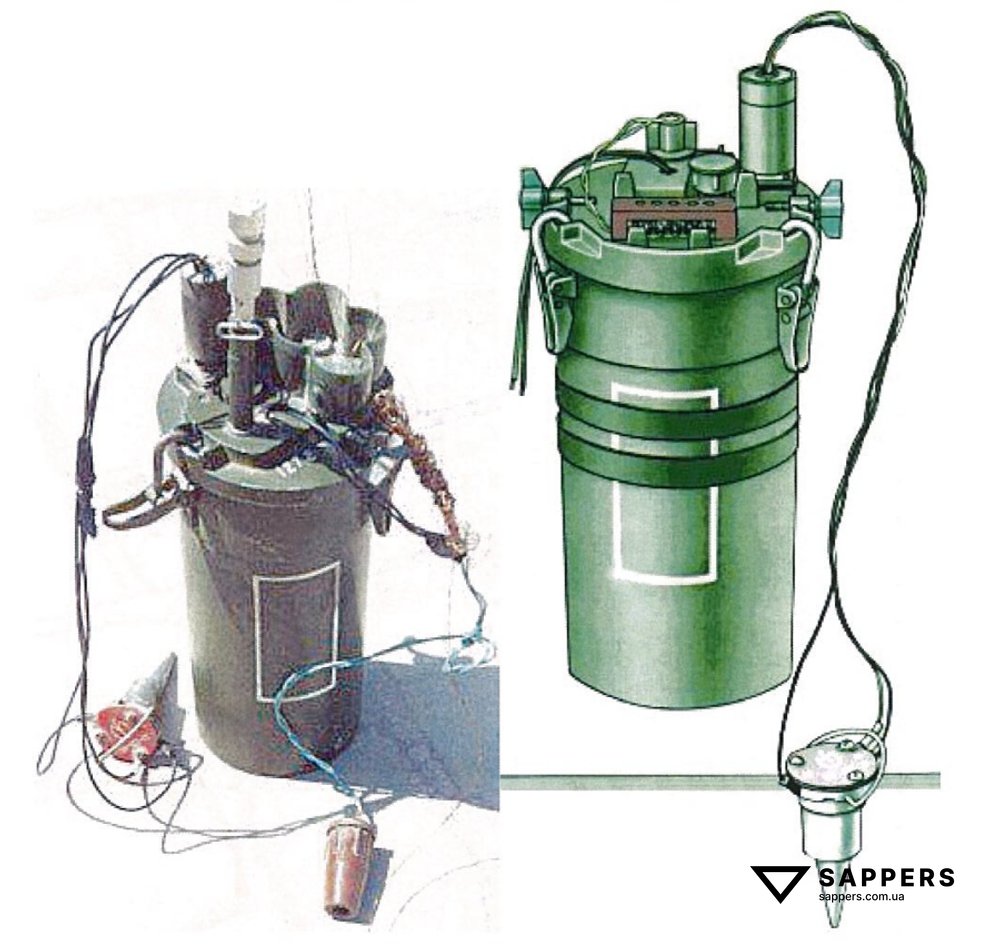
NVU-P allows the emplacement of command-controlled and uncontrolled groups of antipersonnel mines consisting of five OZM-72 or MON-50 mines (standard) and ensures sequential detonation of the mines in the group. Each time a person enters the detection zone, only one of the five mines detonates.
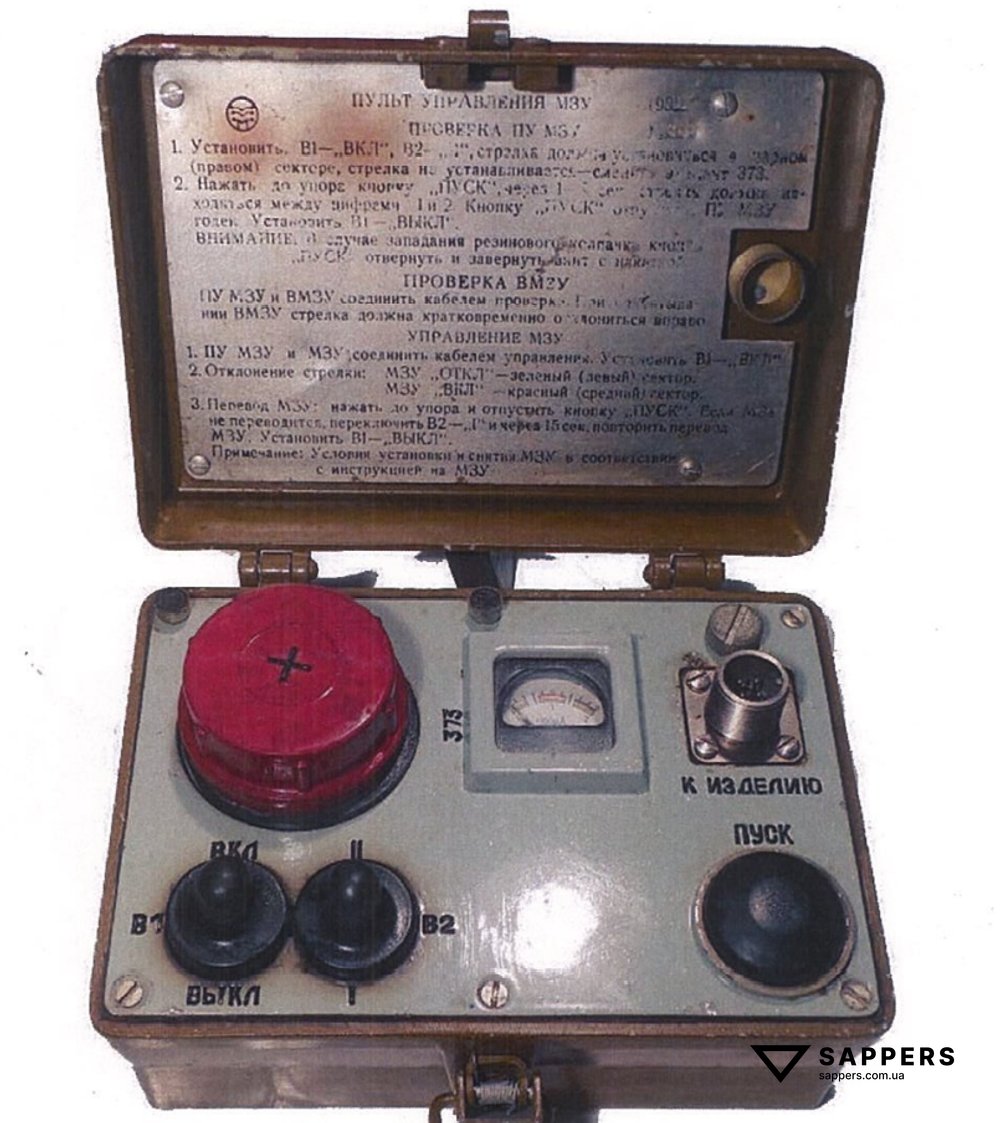
When the NVU-P is emplaced in the command-controlled configuration, repeated switching of the device to the armed or safe position is carried out from the MZU control panel via a two-wire cable. The length of the control line is determined by the resistance of the cable used and the capacity of the power source connected to the MZU control panel, and may be up to several hundred meters.

The NVU-P device consists of an actuator-distribution unit (electronic unit), an SV-20P seismic target sensor, five NM electric striker devices, five reels with micro-electric cable, an MUV-4 fuze, and five antipersonnel fragmentation mines. In addition, one testing and adjustment unit or Ts4313 combined instrument is issued for every twenty sets, and one MZU control panel for every 12 sets. Separately, each NVU-P set is supplied with one TNT charge weighing 75, 200, or 400 grams.

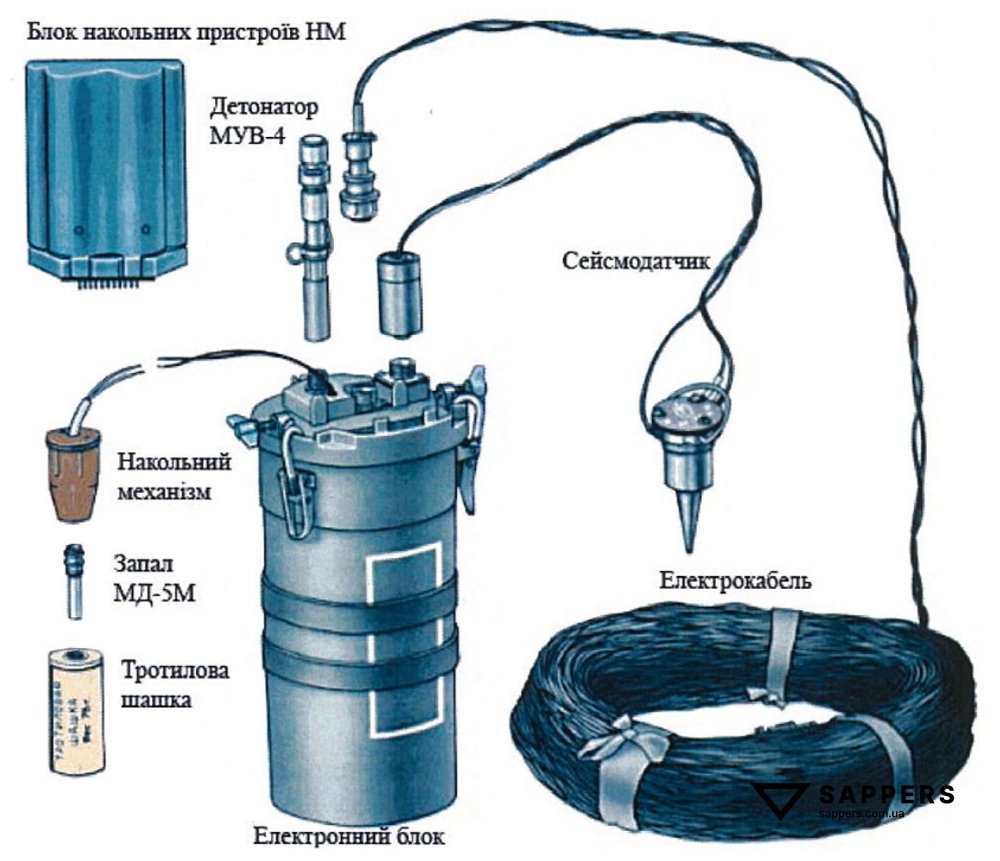
Operation of the device: five antipersonnel fragmentation mines are connected to the actuator-distribution unit by means of electric cable and are emplaced in accordance with the selected mine-laying scheme. A two-core insulated copper microcable is run from the device to each mine. The standard mines of the set are OZM-72 or MON-50 mines; it is possible to connect any antipersonnel fragmentation mines that have sockets for attaching MD-UM detonators (MON-100, MON-200, POMZ3-2M, OZM-3, OZM-4, POB) or mines that can be initiated by an electrical impulse (OZM-160, OZM with UVK, OZM-3).
A seismic sensor connected to the device by cable is buried in the ground near the actuator-distribution unit.
At the operating site, the device remains continuously in standby mode. When moving targets (equipment, personnel) appear in the detection zone, the seismic sensor transmits the registered ground vibrations to the device. The received information is processed in the device, and the nature of the target and its distance are recognized. If the target is identified as a person, the device switches to combat mode. The distance to the target and its azimuth are refined. As soon as the target is within the effective engagement zone of one or more mines, the mine closest to the target is determined, after which an electrical impulse is sent to the electric striker device connected to the mine, and one mine detonates. Control of all available mines is carried out in the same manner. The NVU-P device may also be emplaced together with the VUZ-8 firing device, which allows the connection of eight mines at once.

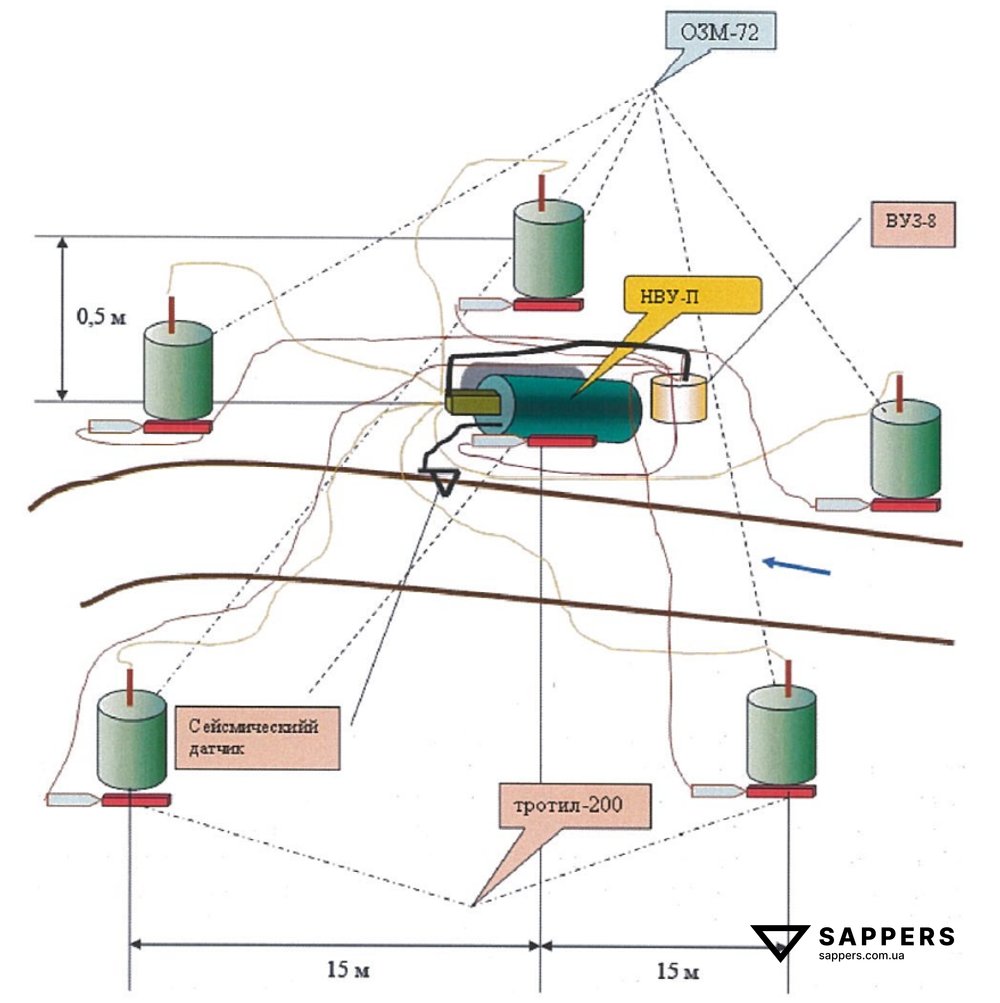
Explanation of the figure above: Emplacement scheme for a group of OZM-72 antipersonnel mines with anti-lift protection and self-destruction on a trail using MVZ-72, MVZ-NS, and VUZ-8. Self-destruction of the mines is achieved by placing TNT charges under the OZM-72 mines, connecting the VUZ-8 to the self-destruction device of the NVU-P electronic unit, and connecting striker mechanisms to 200 g TNT charges placed on each OZM-72 mine and on the NVU-P electronic unit. The mines are emplaced along the trail, the NVU-P electronic unit beside the trail, and the seismic target sensor directly under the trail.

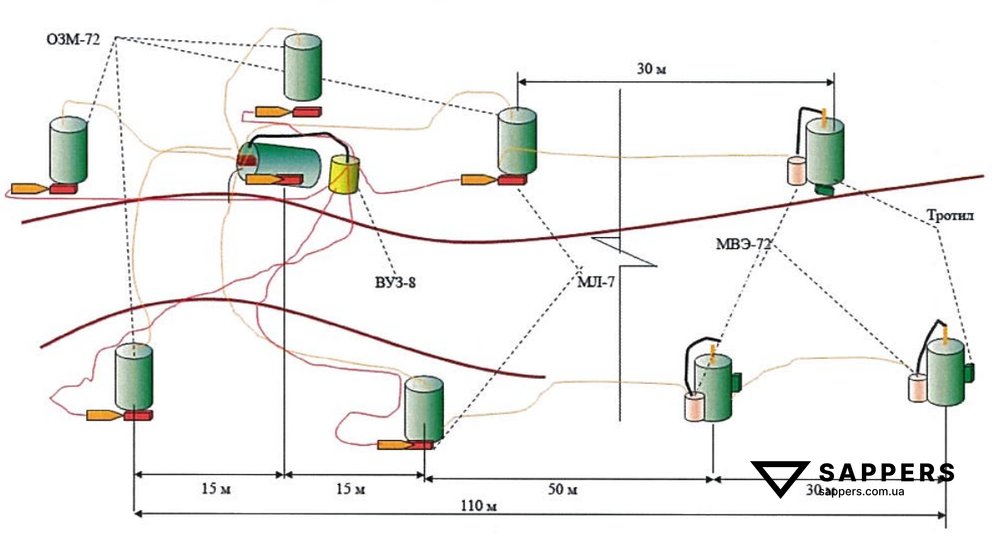
Explanation of the figure above: Emplacement scheme for a group of OZM-72 antipersonnel mines with anti-lift protection and self-destruction on a trail using MVZ-72, MVZ-NS, and VUZ-8. Self-destruction of the mines is achieved by placing TNT charges and/or ML-7 booby-trap mines under the OZM-72 mines, connecting the VUZ-8 to the self-destruction device of the NVU-P electronic unit, and connecting striker mechanisms to 200 g TNT charges (or ML-7) placed on each OZM-72 mine and on the NVU-P electronic unit. The mines are emplaced along the trail, the NVU-P electronic unit beside the trail, and the seismic target sensor directly under the trail.
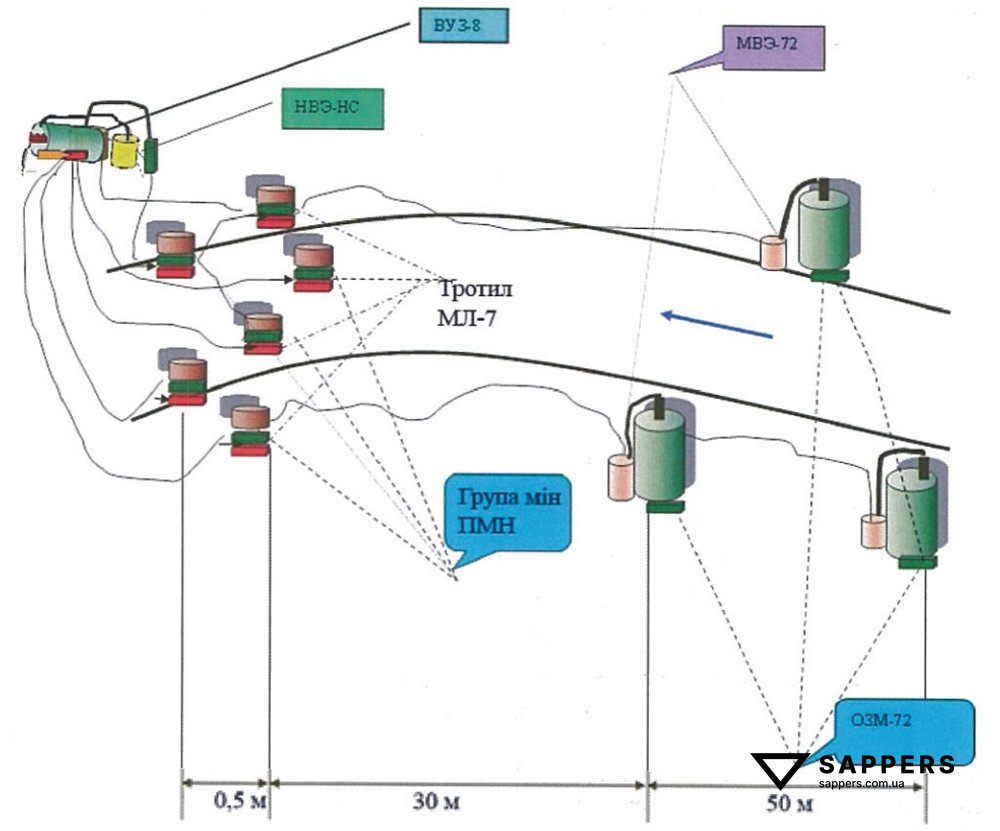
The following figure indicates: The emplacement of antipersonnel mines was carried out using PMN mines. To create a mine trap and increase the area of effect, an MVZ-72 break-wire target sensor is routed under every three PMN mines located in the group of mines on the trail. When a mine is actuated, the break-wire sensor is severed, initiating an OZM-72 mine or group of mines and thereby providing an engagement depth of up to 80 meters.
Anti-lift protection and self-destruction of the mines are provided by placing an ML-7 booby-trap mine and 200 g TNT charges under each PMN mine. The NVU-P with VUZ-8 is emplaced next to the group of mines. Its striker mechanisms are routed to each TNT charge. The striker mechanisms are screwed onto MD-3M detonators, which are inserted into the sockets of the TNT charges. The MVZ-NS mine detonator is emplaced together with the VUZ-8. The MVZ-NS striker mechanism is screwed onto the primer with the VUZ-8 detonator. This ensures self-destruction of the mine group when the voltage in the MVZ-NS power cells drops, and prevents removal of the VUZ-8 in the event of an attempt to unscrew the MVZ-NS striker mechanism.

The device identifies human movement (walking, running, crawling slowly or quickly, movement on skis) and distinguishes it against the background of vehicle and animal movement under any soil and weather conditions. The probability of error is 0.0004. If the soil conditions where the NVU-P is used differ significantly from the reference conditions, the device is first trained and adjusted for the specific terrain conditions using the testing and adjustment unit. These settings, recorded by the testing and adjustment unit, may be used to adjust all other devices that will be emplaced in the given area.
For OZM-72 type mines, the target detection range is approximately 120-150 meters, and the range at which the detonation command is issued is approximately 15 meters.


Thus, during the detonation of any mine, a person is within the effective engagement zone.
This explosive device also has another conventional name, “Okhota Set.” The essence of this device is simple: it is a mine that detonates five times in succession.
There is no practical way to approach and neutralize it.
Seismic sensors are practically impossible to deceive. They are practically impossible to detect by any devices or instruments, because there are currently no instruments that detect mines from a distance of 150 meters.
Moreover, this item is highly treacherous. When the first soldiers are blown up, medics or comrades rush to them, assuming it is a conventional detonation on a conventional mine. But a second mine detonates, incapacitating the rescuers. An attempt by the wounded to crawl out of the engagement zone results in the detonation of a third mine. The OZM-72 mine detonates at a height of about 1 meter, affecting both walking and crawling personnel.
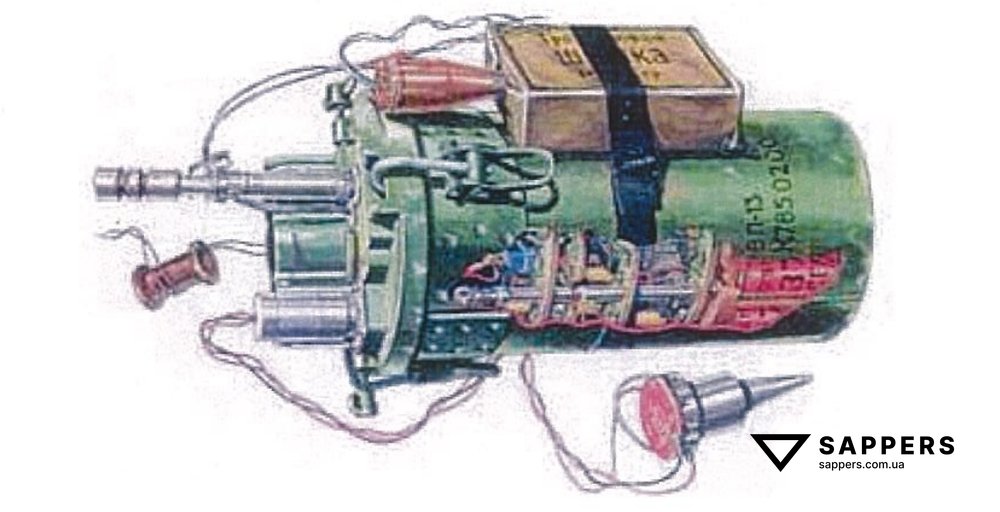
The device has no internal self-destruction mechanism, but if self-destruction is intended, a TNT charge is attached to the body of the device with insulating tape (the attachment point is marked with a white rectangle). An MD-5M detonator is inserted into the charge, to which the electric striker device is screwed. The charge detonates when a self-destruction command is issued after all five mines have functioned, or when the voltage of the power source falls below the minimum permissible value.
The design features of the NVU-P and its emplacement make it possible to consider the group of mines non-removable and non-neutralizable.

The standard initiating device for the NVU-P is the MUV-4 fuze without a detonator, but MUV-2 and MUV-3 fuzes may be used. The delay time is determined by the delay time of the fuze used. In addition, it is possible to bring the NVU-P into the armed position in the uncontrolled configuration remotely by means of a blasting machine or another power source. In this case, instead of the MUV-4 fuze, an NM electric striker device connected by a wire line to the blasting machine is used. However, in this case it is not possible to issue a command to switch the NVU-P to the safe position.