
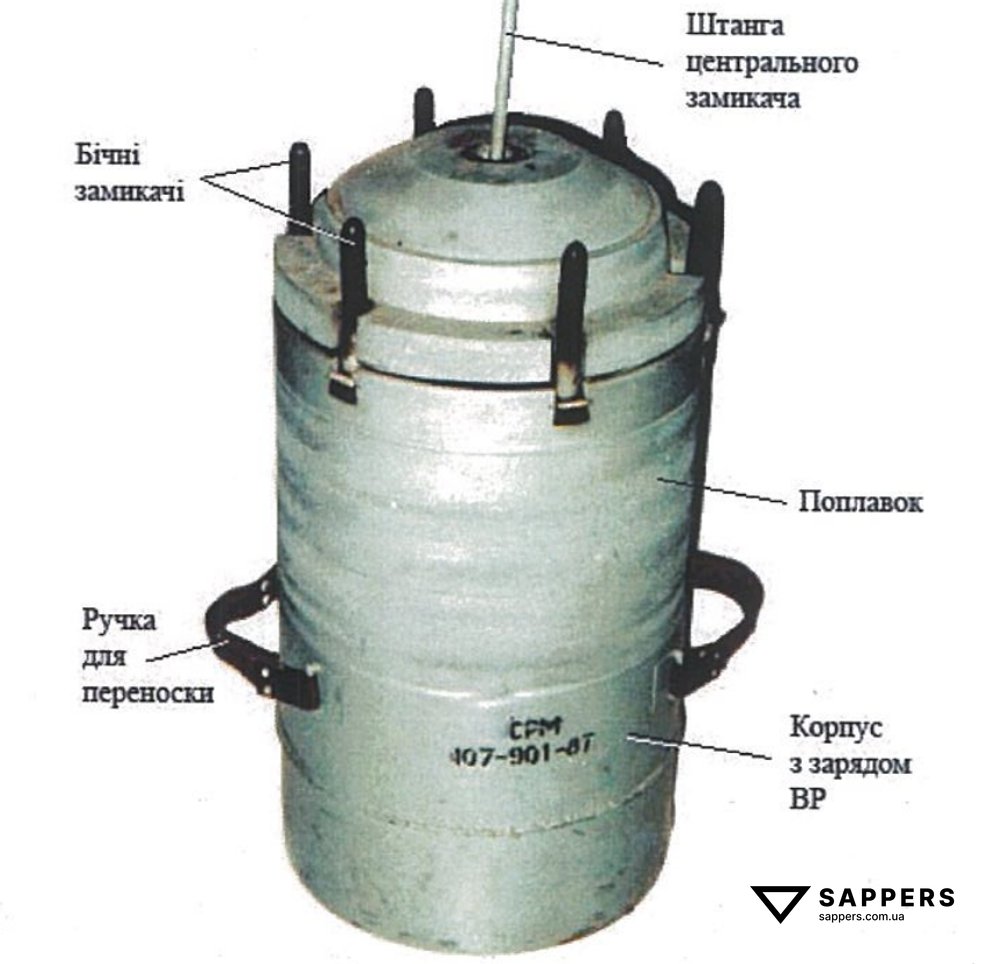
Tactical and Technical Characteristics of the SRM Mine
- Type of mine
- target drifting high-explosive mine, electromechanical action
- Body
- steel, foam plastic
- Weight
- 40 kg
- Weight of explosive charge
- 20 kg
- Type of explosive
- TNT
- Diameter
- 310 mm
- Height
- 580 mm
- Type of central target sensor
- Inclined rod with electric contact switch
- Rod inclination angle for actuation
- 14-20°
- Actuation force of the central target sensor
- 0.6 kg
- Type of six side target sensors
- flexible rods with electric contact switches
- Side target sensor inclination angle for actuation
- 13-30°
- Actuation force of the side target sensor
- 0.25 kg
- Time to armed condition (depends on water temperature)
- 5-40 minutes
- Self-destruction
- 6 hours - 18 days (ChMV-16 detonator)
- Response of the VPZ-1 detonator to the detonation of a neighboring mine
- up to 15 meters
- Operating temperature range
- 0 to +30 °C
Enemy targets and vehicles are defeated by the force of the explosion and by the hydraulic shock in the water during detonation of the mine’s explosive charge when at least one sensor comes into contact with the target.
The mine is highly effective against watercraft, pontoon bridges, and ferries. It is reasonably effective against wooden bridges. Against large bridges on strong stone or reinforced-concrete piers, this mine is ineffective and is unable to cause significant damage.
The mine’s buoyancy is calculated so that, when it is placed in the water, only part of the mine’s upper surface, the central target sensor, and the six side target sensors remain above the water level. The mine is placed in the water upstream of the target to be destroyed and drifts with the current. When any of the target sensors encounters an obstacle, it deflects and closes the mine’s firing circuit, causing detonation of the explosive charge.
If, within the preset time (from 6 hours to 18 days), the mine does not encounter a target or another obstacle, it self-destructs by detonation. The ChMV-16 delayed-action detonator is used as the self-destructor. The mine may additionally be fitted with a VPZ-1 detonator. In this case, the mine detonates when an identical mine located nearby (up to 15 m) detonates.
The mine consists of a body, an explosive charge, a booster detonator, a float, six side contact switches, a central contact switch with a rod, a safety device, an anti-neutralization element, a self-destructor, a power source, a ZZU electric igniter device, and a No. 8-A detonator cap. The body is filled with an explosive charge. The lower part of the body has a chamber containing the central auxiliary detonator, the safety device, the power source, and a plastic panel with a socket for the self-destructor and with the anti-neutralization element. On the side of the body there is a cup with a side auxiliary detonator, adjacent to which is the socket for the VPZ-1 detonator.
In the upper part of the float, six side contact switches are secured in cutouts, and in the center there is a socket containing the central contact switch. The contact switches serve to close the mine’s electric firing circuit when it encounters an obstacle. All contact switches are connected to the electric firing circuit in parallel.
The central auxiliary detonator is a cylindrical TNT block weighing 240 grams with an igniter socket, located in the chamber. The central contact switch, with the rod screwed into it, serves to close the mine’s electric firing circuit when the rod encounters the superstructures of low-water and floating bridges with a clearance above the water of no more than 1.5 m. Closure of the rod contact occurs when the rod, together with the bushing, is inclined at an angle of 14-20°. The rod is collapsible and consists of two main metal sections with a total length of 1.2 m and an additional section. The length of the rod with the additional section is 1.8 m.
The safety device with a sugar safety element ensures safety during preparation prior to mine emplacement and connects the power source to the electric firing circuit after the safety delay has elapsed (after dissolution of the sugar safety element). Each mine is supplied with two sugar safety elements in a plastic box. The sugar dissolution time is 5-40 minutes.
The anti-neutralization element consists of a spring-loaded button with a contact washer and two contacts connected to the mine’s electric firing circuit. When the chamber is closed, the cover presses the button and keeps the electric firing circuit open. If an attempt is made to open the chamber, the electric firing circuit closes and the mine detonates.
When destroying hydraulic engineering structures, the mines are fitted with VPZ-1 detonators and floated down to the structure in groups, usually 20-40 units, because many of them are simply driven against the bank, or they detonate upon encountering random obstacles (snags, piles, protruding stones, etc.). However, delivering such a large number of mines to the river, given their heavy weight, is rather problematic, because they are usually employed in the enemy rear.
Coloring
Gray, protective green, or black.
Marking
Standard duplicate marking, applied in black paint on the side wall of the float and containing:
- SRM - mine code.
- 107-901-82 - manufacturer’s plant code - batch number - year of manufacture.
- T - filling code.