Technical and tactical characteristics of the MSK-40 and MSK-40P mines
- Mine type
- audible signal, illumination
- Body
- steel
- Weight
- 1 kg
- Diameter
- 40 mm
- Height
- 350 mm
- Target sensor sensitivity
- 1-17 kg
- Operating temperature range
- -40 to +50 °C

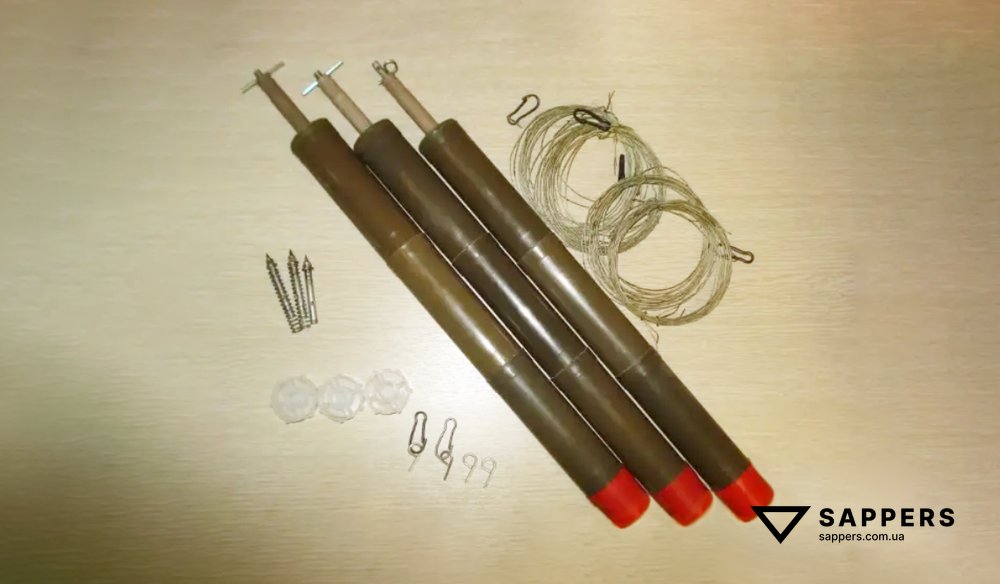
The mine is emplaced manually in the ground with a 2-3 cm camouflage layer; when emplacement in the ground is not possible, it is placed on the ground (in this case the mine is tied to a stake driven into the ground). The mine may also be emplaced by fastening it to various local objects (poles, trees, etc.) or in snow to a depth of up to 70 cm.
The mine’s combat service life is 10 years. It is not fitted with a self-destruct mechanism. It has no anti-lift or anti-neutralization devices; however, the very high sensitivity of the MUV-series fuze makes mine neutralization impossible. Currently, in the Russian Federation, special fuzes have been developed for the mine that have combined seismic and infrared sensors. These fuzes prevent approaching the mine to neutralize it and make covert movement within its area of effect impossible.
Operating principle:
Four signal stars in red, green, white, and blue are ejected from the body to a height of up to 30 m. Then 10 illuminating stars are ejected to a height of up to 30 m, illuminating the terrain within a radius of 170-200 m for 23-28 seconds. The gases of the expelling propellant charge, passing through the whistle, produce a sharp, loud whistling sound for the entire duration of the stars’ ejection. The audible signal can be heard at up to 500-800 m, and the signal stars are visible at not less than 500 meters. In the MSK-40P, two additional light-and-sound stars are ejected.
Coloring
Green, protective.
Marking
Applied in black paint to the side surface and contains:
- MSK-40 - mine code.
- RF-98-04-01 - country of manufacture - manufacturer’s plant code - batch number - year of manufacture.