The railway detonator is used for:
- providing a warning or stop signal in dense fog, when there is a high probability that visual signals will not be seen;
- warning of an occupied section of track due to an incident or accident;
- warning of ongoing urgent repair work on the line;
- when it is necessary to urgently stop an approaching train in an emergency situation.
The detonator is attached to the rail manually by means of a spring. To increase the reliability of the warning and to distinguish the stop signal from all kinds of extraneous sounds, railway detonators are used in sets of three in succession, placed along the rails at intervals of 20 meters: two on the right-hand rail of the track in the direction of train movement and one on the left-hand rail, midway between the first two.
Tactical and technical characteristics of PZhV and PSZh detonators
- Type
- signal, light-and-sound detonator
- Casing
- steel
- Weight
- 0.08 kg
- Weight of explosive substance, DRP-1 black powder
- 0.0165-0.018 kg
- Diameter
- 65 mm
- Height
- 11.3-12.7 mm excluding the spring
- Operating temperature range
- -20 to +50 °C

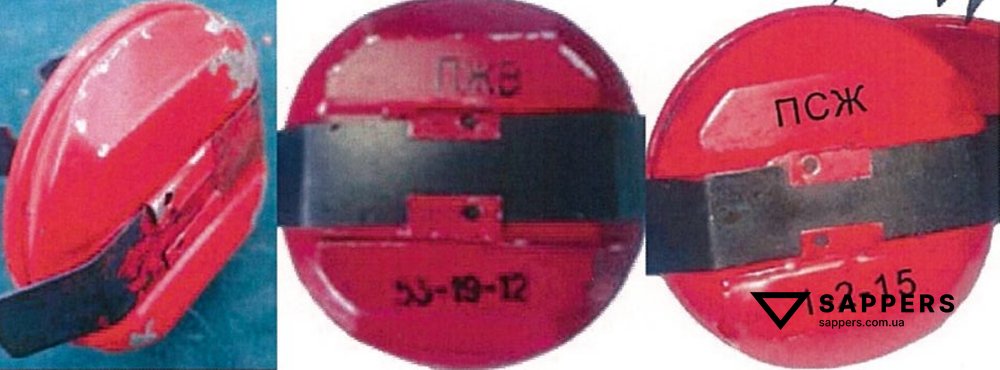
When a train wheel runs over the detonator, it explodes very loudly with a burst of flame and a gray smoke cloud.
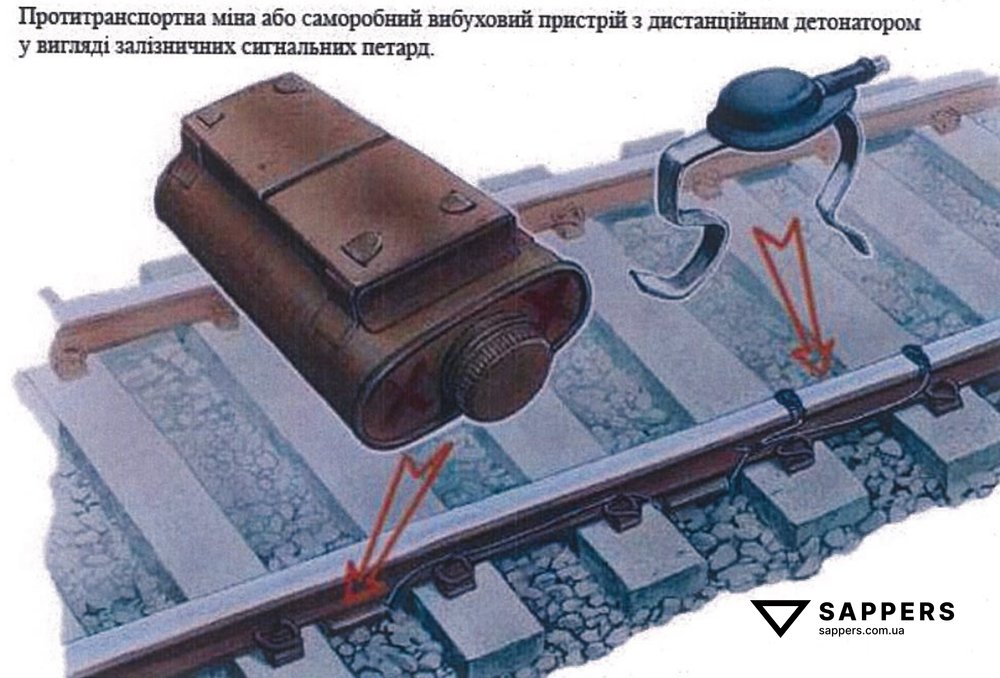
This detonator was actively used as an anti-train initiator during World War II. The flash from the powder charge initiated a blasting cap, to which a section of detonating cord was connected, leading to the main explosive charge. It can be used in the same manner today.

Coloring
Red.
Marking
On detonators manufactured before 2008, the marking is stamped on the spring and includes the manufacturer’s trademark, year of manufacture, and OTK inspection stamp.
On detonators manufactured after 2008, the marking is applied in black paint on the detonator casing and contains:
- PZhV (Petarda zheleznodorozhnaya vzryvchataya) or PSZh (Petarda signalnaya zheleznodorozhnaya) - mine code. Different factories in the Russian Federation use different names for the detonators, but it is the same device.
- 1-2-15 - manufacturer’s factory code - batch number - year of manufacture.